
What The Sales Debrief taught me about peer learning, accountability, and helping people move forward.
I’ve spent years working with entrepreneurs, and there’s something I keep noticing: people often have a pretty good idea of what they need to do next. They know they should follow up with that potential client, clarify their offer, have a conversation about pricing, or finally make a decision they’ve been putting off.
But knowing what to do and actually doing it are two very different things.
Sometimes, what’s missing isn’t another course or a presentation full of advice. It’s having someone ask the right question, challenge your thinking, and follow up on what you said you would do.
That’s one of the biggest lessons I learned from creating The Sales Debrief, a live online group that brings entrepreneurs together to discuss their business challenges, exchange perspectives, and work toward their goals.
And I believe this kind of experience has a place in many more settings than we might initially think.
For organizations delivering entrepreneurship programs, employment programs, or professional development initiatives, a facilitated business accountability group can complement existing training and give participants something they don’t always get in a classroom: ongoing, personalized support while they’re putting what they’ve learned into practice.
How The Sales Debrief started

In the summer of 2025, I attended the Hello Seven Millionaire Summit in California, an event that brought together women entrepreneurs from different industries, backgrounds, and stages of business.
I met some incredible women there. We exchanged ideas, talked about our businesses, and connected over experiences that, despite our different circumstances, had quite a few things in common.
Like many conferences, the event eventually ended, and everyone returned home. But I didn’t want those conversations to stop there.
A few of us stayed connected through WhatsApp, and I offered to bring everyone together for a weekly online call focused on sales. That’s how The Sales Debrief started.
It wasn’t something I had spent months developing. I saw an opportunity to bring people together, offered to facilitate the conversations, and we got started.
We had women joining from Montréal, New York, Florida, South Carolina, Illinois, Washington, D.C., and other locations. Their businesses were completely different. We had people working in wellness, photography, publishing, consulting, travel experiences, and professional services.
Yet when we started talking about what was happening in our businesses, many of the challenges were surprisingly similar: finding clients, following up, talking about money, managing priorities, deciding which opportunities were worth pursuing, and sometimes simply doing the things we had already decided were important.
What makes The Sales Debrief different from a traditional entrepreneurship workshop?
Most entrepreneurship workshops are built around a predetermined topic. You register for a session on marketing strategy, sales techniques, pricing, or business planning. The facilitator prepares the material, participants attend, and everyone hopefully leaves with something useful.
There’s absolutely a place for that. I design and facilitate those workshops through Abundance Bureau. But The Sales Debrief works differently.
We don’t start with a presentation. We start with the people in the room.
Participants arrive with whatever they’re currently working through. One person might be preparing to launch a new service. Another might have plenty of leads but struggle to convert them into clients. Someone else might be trying to figure out why their marketing activities aren’t producing results.
My role as the facilitator is to listen, ask questions, identify what’s really happening, and help the group explore practical solutions. Sometimes that means sharing my expertise in marketing and sales. Sometimes it means challenging a participant’s assumptions. And sometimes the most valuable insight comes from another person in the group.
The format is live, interactive, and responsive. The content evolves based on participants’ needs rather than following a fixed curriculum. That’s why I describe The Sales Debrief as a live, facilitated business accountability circle: part peer learning, part business coaching, and part accountability.
Five things The Sales Debrief taught me about entrepreneurship education
1. People don’t always need more information. They need help making decisions.
Entrepreneurs have access to an incredible amount of information. There are courses, podcasts, webinars, books, videos, and now AI tools that can help answer almost any business question. Information isn’t always the problem.
During our Sales Debrief sessions, I noticed that participants often knew what they wanted to accomplish. The challenge was figuring out what to prioritize, deciding how to approach it, or finding the confidence to move forward.
For example, a participant might know that following up with potential clients is important but hesitate because she doesn’t want to appear pushy. We can spend an hour explaining the importance of sales follow-ups. Or we can have a conversation about why she’s hesitating, explore what a thoughtful follow-up might look like, and help her decide who she’s going to contact next.
Those are two very different learning experiences. The second one addresses the situation she’s facing right now. As a facilitator, I don’t believe my job is simply to give people answers. It’s also to help them think through their options and make decisions they can stand behind.
2. Accountability is often the missing piece.
One of the simplest things we did during The Sales Debrief was ask participants what they planned to accomplish before our next meeting. Nothing complicated. What are you working on? What’s getting in the way? What will you do next?
Then, when we met again, we revisited those commitments. Did you send the proposal? Did you follow up with those leads? Did you have the pricing conversation? What happened?
And if something didn’t get done, we talked about it. Not to make anyone feel bad, but to understand what was happening. Maybe the goal wasn’t realistic. Maybe another priority came up. Maybe the participant was avoiding a difficult conversation.
This is something I think many entrepreneurship and employment programs could benefit from. Participants often leave a workshop with good intentions. But what happens a week later? Or a month later? A recurring accountability circle creates an opportunity to reconnect learning with real-life action.
3. Different businesses can learn from the same conversation.
One of my favourite things about The Sales Debrief was the diversity of businesses represented. We had entrepreneurs offering completely different services to completely different audiences.
At first, you might wonder what a wedding photographer, a wellness entrepreneur, and a fundraising consultant could possibly learn from one another. Quite a lot, actually.
Take client acquisition. A photographer might be struggling to generate inquiries. A consultant might have leads but need to improve her follow-up process. A wellness entrepreneur might have an engaged audience but no clear path from interest to purchase.
The situations are different, but the underlying questions are connected. Who are you trying to reach? What do they need? How are you communicating your value? What happens after someone expresses interest?
During one of our sessions, we discussed challenges related to pricing conversations, client inquiries, referrals, and partnerships. Participants shared suggestions based on their own experiences, while I helped connect those ideas to practical marketing and sales decisions.
This is the beauty of peer learning. People don’t need to work in the same industry to learn from each other. Sometimes an outside perspective is exactly what helps someone see a problem differently.
4. A good facilitator doesn’t just encourage people. They challenge them.
Creating a supportive environment matters to me. I want participants to feel comfortable sharing what they’re experiencing, including the things that aren’t going particularly well. But support doesn’t mean agreeing with everything someone says.
Sometimes my role is to ask a question that makes someone reconsider their approach. Why are you spending so much time creating content if you’re not following up with interested clients? Are you sure you need another marketing tool, or do you need a clearer process? What evidence do you have that this is what your customers want? What’s stopping you from having that conversation?
These aren’t questions designed to put people on the spot. They’re meant to help participants think critically about their decisions.
And because my background includes both marketing strategy and active B2B sales, I can bring practical experience into those conversations. I know that selling isn’t always comfortable. I know that client acquisition involves uncertainty, follow-ups, objections, and decisions about where to invest your time.
A live business workshop gives us the opportunity to work through those realities as they happen.
5. Progress looks different for everyone.
Not every participant in The Sales Debrief had the same definition of success. Some wanted to increase sales. Others wanted to improve their systems, become more confident in conversations with potential clients, or make better decisions about their offers.
One participant might celebrate signing a new client. Another might celebrate finally sending a proposal she’d been postponing. Both are meaningful.
This matters when designing programs for people at different stages of their entrepreneurial or professional journeys. If we only measure success by revenue or business launches, we can miss important signs of progress.
Learning how to communicate your value, set boundaries, organize your work, or follow through on a commitment can make a difference well beyond entrepreneurship.
What participants said about The Sales Debrief
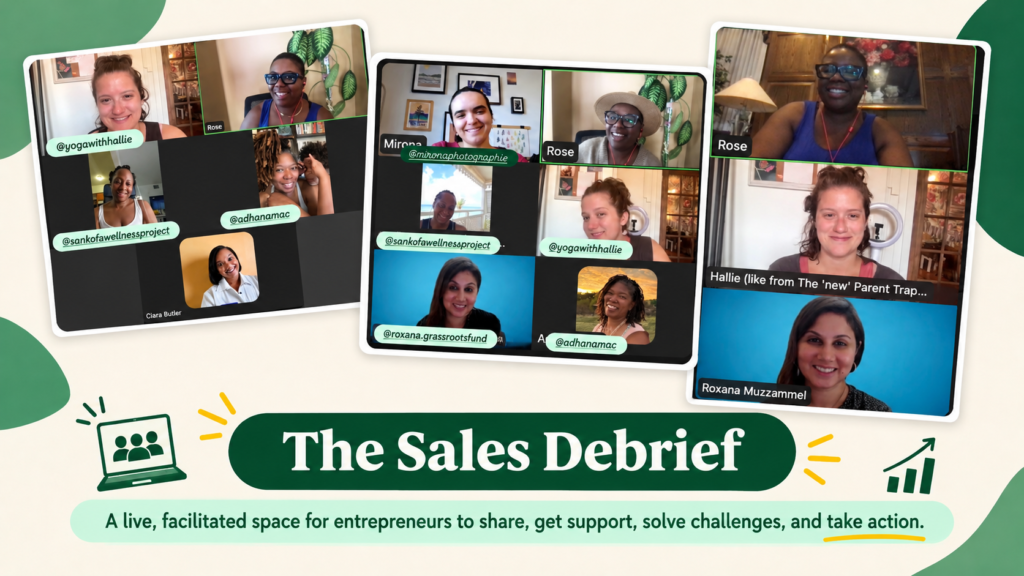
I can explain how the group worked, but I think the participants describe its value better than I can. One of the things that stood out in their feedback was how much they appreciated having a consistent place to discuss their challenges and receive support.
“Before these calls, I saw myself as ‘trying to run a business.’ Now, I confidently see myself as a business owner with a network who are committed to one another’s growth and success.”
— Rufiena Jones, Sankofa Wellness project
For me, that captures something important about entrepreneurship education. Beyond teaching business skills, we can help people develop confidence in their ability to make decisions, solve problems, and take ownership of their professional journey.
“Rose is a great facilitator and Accountability holder.”
— Selina Kelly, DisruptHer Coach
Her review also highlighted the structure of the sessions, the focused conversations, and the importance of having someone remember participants’ commitments.
And some participants reported measurable business improvements. Hallie Brevetti, an entrepreneur based in Brooklyn, shared that her average monthly business revenue increased from $800 to $1,200 within a couple of months of joining the weekly calls. Ciara Butler, based in Florida, also reported that identifying inefficiencies in her business processes and receiving practical sales guidance helped her address challenges and improve revenue.
These are individual experiences shared by participants, not guaranteed outcomes. But they illustrate the kinds of changes that can happen when people have access to relevant expertise, thoughtful questions, and consistent support. What matters to me is that participants weren’t simply listening to information. They were working through their own situations and deciding what to do next.
Could this type of business workshop work inside an existing program?
Absolutely. And I think this is where The Sales Debrief becomes particularly interesting for organizations.
Imagine an entrepreneurship program that already offers training in business planning, marketing, finance, and operations. Participants attend workshops, complete exercises, and learn important concepts. But between those sessions, questions come up.
Someone is struggling to explain their offer. Another participant is preparing for their first sales conversation. Someone else has started promoting their business but isn’t sure whether their efforts are working.
Instead of waiting for the next scheduled training session, participants could join a live, facilitated accountability circle. They would have access to a marketing and sales specialist who could help them work through their questions, challenge their thinking, and identify practical next steps.
Entrepreneurship programs
For organizations supporting aspiring or early-stage entrepreneurs, The Sales Debrief could complement existing training by helping participants apply what they’re learning to their own businesses. Discussions could cover positioning, customer discovery, marketing activities, sales conversations, pricing, and client acquisition. The goal wouldn’t be to replace the curriculum. It would be to support participants while they’re putting it into practice.
Employment and career development programs
Not everyone wants to start a business. Some people want to explore a career change, develop a professional project, build confidence, or become more comfortable presenting their skills and ideas.
A facilitated accountability circle could be adapted to help participants clarify their goals, practice communicating their value, work through obstacles, and follow through on commitments. In this context, the emphasis would shift from business sales to professional development, initiative, and decision-making.
Incubators and accelerators
Founders in incubators and accelerators often have access to valuable resources, mentors, and specialized training. But they also face decisions that don’t always fit neatly into a workshop agenda.
A recurring business accountability circle could provide a space to discuss current challenges, test ideas, receive feedback, and maintain momentum between program milestones.
Community organizations
Community organizations support people with different backgrounds, experiences, resources, and ambitions. Some participants may be exploring entrepreneurship for the first time. Others may already have a project underway but need help organizing their next steps.
A small-group format can make room for different experiences while creating opportunities for participants to learn from one another. The important part is adapting the facilitation to the people participating, rather than expecting everyone to arrive with the same goals.
How could The Sales Debrief be integrated into your organization?
One of the advantages of this model is its flexibility. Because sessions are delivered live online, an organization wouldn’t necessarily need to develop a new course or significantly change its existing program.
The Sales Debrief could be offered as a recurring activity within a cohort, as a complement to entrepreneurship training, or as ongoing support for participants working on business or professional projects.
- Small-group online sessions: Participants meet regularly with a specialized facilitator.
- Real-time questions and discussion: Each session responds to the challenges participants are currently facing.
- Marketing and sales expertise: Participants receive practical guidance relevant to their projects.
- Peer learning: Participants exchange experiences, ideas, and perspectives.
- Individual commitments: Each person identifies realistic next steps.
- Follow-up and accountability: Progress, obstacles, and decisions are revisited in subsequent sessions.
The frequency, duration, group size, and areas of focus could be adapted to the organization’s objectives and the needs of its participants. And because Abundance Bureau works in both English and French, the format can be offered to organizations serving different communities across Canada. For organizations in the United States, the same approach can be delivered online in English.
Interested in bringing a live business accountability circle to your organization? Let’s discuss your program’s needs: https://form.typeform.com/to/gciGPBL6
What should organizations look for in a business workshop facilitator?
I think it’s important to distinguish between someone who can deliver a presentation and someone who can facilitate a productive conversation. Both require skills, but they’re not the same thing.
When participants arrive with different questions, experiences, and personalities, the facilitator needs to be able to listen carefully, identify common themes, manage the conversation, and help people move toward useful conclusions. They also need to know when to offer advice and when to ask another question.
In The Sales Debrief, I wasn’t working from a script. I had to respond to what participants brought to each session. That required a combination of marketing and sales knowledge, business experience, preparation, and the ability to create a space where people felt comfortable contributing.
It’s an approach I bring to my work through Abundance Bureau. I believe the most valuable workshops don’t simply leave people feeling inspired for an afternoon. They help people understand their situation more clearly and decide what they’re going to do about it.
How can organizations measure the value of a business accountability circle?
Not every outcome needs to be measured in revenue. For an entrepreneurship program, client acquisition, completed sales activities, or progress toward launching an offer might be relevant.
For an employment program, meaningful indicators could include improved confidence in communicating professional skills, completed action plans, or progress toward career-related goals.
Organizations could also look at participation, completion of agreed-upon actions, clarity of goals, and feedback from participants.
A simple approach would be to ask participants where they are at the beginning of the experience, track the commitments they make during sessions, and review what has changed over time. The goal is to measure progress in a way that reflects the purpose of the program and the realities of the people participating.
Frequently asked questions about The Sales Debrief
What is The Sales Debrief?
The Sales Debrief is a live online business accountability circle developed by Abundance Bureau. It combines facilitated discussions, marketing and sales expertise, peer learning, and practical goal setting to help participants work through current challenges and make progress.
Is The Sales Debrief an entrepreneurship workshop?
It can complement an entrepreneurship workshop or an existing entrepreneurship program. Unlike a traditional workshop with a predetermined presentation, The Sales Debrief is an ongoing, interactive format shaped by participants’ questions and priorities.
Can The Sales Debrief be integrated into an existing entrepreneurship program?
Yes. Organizations can explore incorporating the format into an existing cohort or training program. Sessions can reinforce learning, provide opportunities for practical application, and support accountability between scheduled workshops.
Is this format only for entrepreneurs?
No. The approach can be adapted for aspiring entrepreneurs, business owners, intrapreneurs, and people developing professional or community projects. The discussion topics and objectives would be adjusted to the participants and the organization.
Can employment programs benefit from this type of workshop?
Yes. A facilitated accountability circle can support participants who are exploring professional goals, developing projects, practicing communication skills, or working through decisions. It doesn’t need to focus exclusively on selling products or services.
Are the sessions online or in person?
The Sales Debrief was developed as a live online group. Abundance Bureau can discuss how to adapt the format to an organization’s needs, including opportunities for in-person facilitation where appropriate.
Are sessions available in English and French?
Abundance Bureau offers bilingual facilitation in English and French. The language and format can be discussed based on the participating organization and its audience.
How is The Sales Debrief different from business coaching?
Traditional business coaching often focuses on an individual’s specific goals. The Sales Debrief combines access to a specialized facilitator with the added value of group discussion, shared experiences, and recurring accountability.
Sometimes, what people need most is a place to work things through
When I created The Sales Debrief, I wasn’t trying to develop a new entrepreneurship curriculum. I wanted to keep a group of interesting women connected and create a space where we could talk about what was really happening in our businesses.
What I discovered was how valuable those conversations could become when they had structure, consistency, and someone helping people move from discussion to decisions.
The participants brought their questions, experiences, and ideas. My role was to help them make sense of what was happening, explore possibilities, and identify what came next.
That’s what I love about facilitating. You never know exactly what someone is going to bring into the room. But with the right questions, expertise, and structure, you can help them leave with greater clarity.
And whether someone is building a business, exploring a career, or developing a project within an organization, that kind of support can make a meaningful difference.
Bring The Sales Debrief to your organization
At Abundance Bureau, we design and facilitate interactive marketing, sales, and entrepreneurship workshops for organizations supporting people at different stages of their professional and entrepreneurial journeys.
If you’re coordinating an entrepreneurship program, employment initiative, incubator, accelerator, or community program, I’d love to explore how a live business accountability circle could complement the work you’re already doing.
Plan a workshop with Abundance Bureau
hello@abundancebureau.co
438-371-4750
