
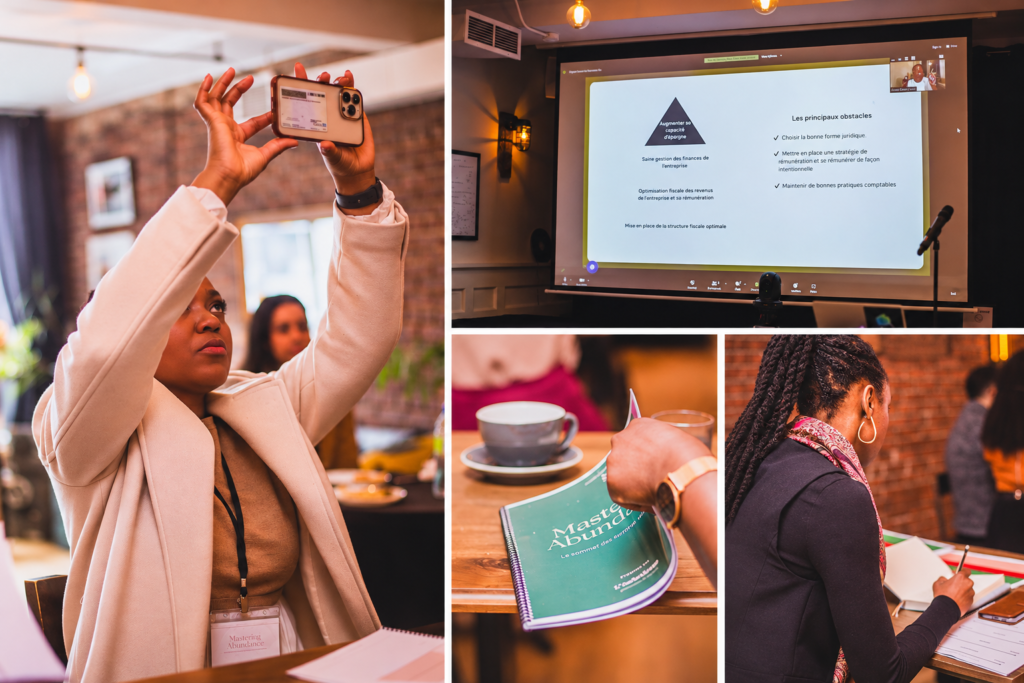
A planning guide for program coordinators at incubators, community organizations, schools, accelerators, and entrepreneurship support centres across Canada.
Planning your next entrepreneurship program? Start with the challenges participants actually face.
You have a new cohort coming up, a calendar to fill, and participants with very different levels of experience. Some are still testing an idea. Others have launched but struggle to attract customers, explain their value, or turn interest into sales. As a program coordinator, you need workshops that do more than sound good on a schedule: participants should leave having practised something they will actually use.
If you are looking for entrepreneurship workshop ideas for your next program, the challenge is not finding topics. It is choosing workshops that are relevant, practical, and appropriate for the people you support.
At Abundance Bureau, we design and facilitate live, bilingual workshops for organizations supporting entrepreneurs and intrapreneurs across Canada. Our approach comes from hands-on marketing work, real B2B sales conversations, and years of facilitating groups—not just presenting theory. Here are nine entrepreneurship workshop ideas, what makes each one different, and how to choose the right mix for your cohort.
9 entrepreneurship workshop ideas for your next cohort
1. On-Camera Communication: Find Your Voice on Camera
The challenge: Video is increasingly part of how founders, professionals, and project leaders communicate, but hiring a production team can cost more than $5,000 while filming alone can feel intimidating. Participants may know their message yet have no idea how to turn it into a video they feel comfortable publishing.
Our approach: This signature workshop is the practical middle ground between a full production crew and figuring everything out alone. We work through the story first: who is the audience, what is the message, what should the viewer understand or do, and how should the speaker deliver it? Then we address where to film, framing, lighting, sound, and the equipment that is actually necessary. A smartphone can be enough. Participants also explore simple editing steps so they can create and improve videos independently, without being dependent on a production company every time.
Best suited for: Entrepreneurs promoting an offer, intrapreneurs presenting a project, and professionals who need to communicate confidently on camera without a large production budget.
Practical takeaway: A short, filmed message with a clear story arc, a simple recording checklist, and a plan to edit and publish it independently.
2. Public Speaking and Business Pitching
The challenge: Participants often say they already know how to pitch. But ask a room of people to explain what the business does, why it exists, and what makes it valuable—and the answers are not always clear to the listeners.
Our approach: We introduce a 4C communication framework and apply it to spoken pitches rather than treating it as theory to memorize. Participants deliver their pitch, hear what the group actually understood about their mission and added value, and try again. The feedback is specific: what was clear, what was confusing, and what deserves more emphasis. The point is not to make everyone sound like a professional speaker; it is to make the message land.
Best suited for: Pre-launch cohorts, pitch-preparation programs, youth entrepreneurship programs, and founders preparing for networking or funding conversations.
Practical takeaway: A tested short pitch, revised after structured group feedback on the business mission, value, and delivery.
3. Marketing Foundations for New Entrepreneurs
The challenge: Many new entrepreneurs think marketing means social media, paid ads, or posting regularly. Those are channels and tactics—not the whole marketing discipline. Starting there can lead to activity without a clear market or commercial objective.
Our approach: We teach marketing as a business discipline, including the 4C marketing framework, the customer and market questions behind positioning, and the numbers that inform decisions. Participants distinguish the overall marketing strategy from digital marketing, which is only one part of it. We connect the work to concrete questions: Who needs this? What value do they see? What does it cost to reach them? What would make the offer financially viable?
Best suited for: Idea-stage founders and first-time business owners who need a practical foundation.
Practical takeaway: A one-page marketing foundation that connects customer needs, positioning, channels, and measurable business goals.
4. Social Media Content Strategy and Editorial Planning
The challenge: Entrepreneurs often create posts one at a time because they feel they should be visible. The result is a lot of production, inconsistent messaging, and little sense of whether the work supports the business.
Our approach: This is one of our most popular workshops because we show the thinking behind building a campaign from scratch. Participants learn to separate a marketing objective—the business result, including revenue—from a communication objective—what people should understand, feel, or remember. We then work backward to an audience, message, content pillars, formats, and editorial plan. Rather than giving people a list of post ideas, we show them how individual pieces of content work together as a campaign. We use real business examples to make the decisions visible.
Best suited for: Entrepreneurs already active on social media but struggling with consistency or direction.
Practical takeaway: A small campaign plan with one business objective, one communication objective, a core message, and a realistic editorial calendar—not just a pile of disconnected posts.
5. Branding: Positioning, Words, and Visual Identity
The challenge: A business can have a strong offer and still create the wrong impression through vague wording, mismatched photos, or inconsistent visuals. Branding is not only a logo; it shapes how people understand and remember you.
Our approach: We help participants articulate their positioning and translate it into both words and visuals. That means examining tone of voice, imagery, colours, and an appropriate visual direction—and asking what each choice communicates to the intended audience. This is not a graphic design or art direction course. It is about developing enough judgment to make coherent choices and brief a designer effectively if needed. For intrapreneurs or employment-program participants, the same principles can help them present their strengths in a résumé, interview, or professional introduction.
Best suited for: Early-stage founders, entrepreneurs refreshing their positioning, intrapreneurs, and people preparing to communicate their professional value in a job search.
Practical takeaway: A concise positioning statement and a simple brand direction board covering words, colours, and image choices.
6. Sales and Customer Communication
The challenge: Sales is often taught as a sequence of ideal steps. Real conversations are messier. Prospects do not answer, say no, hang up, question the price, or disappear after a promising call. Many participants know they should follow up but do not know what to say—or avoid doing it altogether.
Our approach: Drawing on experience in B2B technology sales, we work with what actually happens before, during, and after a customer conversation. Participants research a prospect before a discovery call, practise asking better questions, handle rejection and objections in role-plays, and rehearse pricing conversations. We write follow-up emails and text messages, compare different ways to re-engage a lead, and discuss how a CRM or even a simple spreadsheet can prevent opportunities from slipping away. AI can help draft a follow-up sequence or organize a prospecting plan, but participants still need to exercise judgment and communicate like people. Group debriefs make the awkward parts discussable, not something to hide.
Best suited for: Entrepreneurs who avoid selling, service providers preparing discovery calls, and founders with leads but an inconsistent follow-up process.
Practical takeaway: A rehearsed discovery call, two adaptable follow-up messages, and a simple process for tracking next steps.
7. Email Marketing and Customer Relationships
The challenge: A participant might have a newsletter tool—or a list of contacts—but no strategy for what to send, why someone would read it, or how email supports a customer relationship.
Our approach: We start with the purpose of the email, the audience, and the action it should support. Then we work on structure and writing: a useful subject line, a readable opening, one clear message, and a call to action that fits the relationship. We compare contemporary formats, from a short personal note to an educational newsletter or a simple automated sequence. Participants can explore tools such as Mailchimp and MailerLite, while learning principles they can apply regardless of platform. Permission and list quality matter more than collecting addresses indiscriminately.
Best suited for: Entrepreneurs with an offer, an audience, or early customer relationships.
Practical takeaway: A drafted email in a chosen format and a short sequence connecting the message to a business goal.
8. SEO and GEO Basics: Help Customers Find You
The challenge: Participants may have a website but struggle to explain their offer in the language customers use when searching. Others have heard about AI search and assume there is a trick to appearing in chatbot answers.
Our approach: We begin with actual customer questions, not technical jargon. Participants identify search intent, review whether their pages answer those questions clearly, and practise writing helpful headings, page descriptions, and FAQs. We explain the fundamentals of SEO alongside GEO—making information about a business clear, specific, and easy to understand in AI-assisted discovery—without promising rankings or AI mentions. Local business details, consistent service descriptions, and useful evidence matter more than keyword stuffing.
Best suited for: Entrepreneurs with a website or those preparing their first online presence.
Practical takeaway: A customer-question map and one improved website section or FAQ that answers a real search need.
9. Practical AI Tools for Entrepreneurs and Intrapreneurs
The challenge: People hear that AI can save time, but vague requests produce generic answers. The deeper issue is often not knowing how to communicate the task clearly in the first place.
Our approach: Before introducing a long list of apps, we teach participants how to formulate a useful request: explain the context, define the audience, specify the task, provide constraints and examples, and describe what a good output looks like. We practise improving a weak prompt and checking the response for accuracy, relevance, and tone. Then participants apply the method to a real business or workplace task, such as planning content, preparing customer research questions, or outlining a follow-up process. We also discuss what should not be shared with AI tools and when human judgment is essential.
Best suited for: Mixed-experience cohorts, small teams, and intrapreneurs developing new initiatives inside organizations.
Practical takeaway: A reusable prompting structure, a before-and-after example, and one reviewed AI-assisted workflow for a real project.
How to choose the right entrepreneurship workshops for your program
Nine topics do not necessarily mean nine sessions. A strong program starts with the outcomes you want participants to achieve, not the number of workshops on the calendar.
- Start with the cohort. Are participants exploring an idea, preparing to launch, or already making sales?
- Identify the immediate obstacle. Do they need clearer positioning, stronger communication, more visibility, or a better sales process?
- Match the format to the skill. Pitching, sales conversations, and on-camera communication improve through practice and feedback—not slides alone.
- Plan for different confidence levels. Give participants a way to apply the exercise to their own business or professional project.
- Leave room for follow-through. A useful worksheet, script, recording, or next-step plan makes it easier to continue after the workshop.
For example, a new-founder cohort might start with marketing foundations, branding, and pitching before moving into content strategy or sales. Participants already running businesses may need the less glamorous work: follow-up messages, customer research, and a campaign that connects visibility to revenue. A youth, employment, or intrapreneurship cohort could focus on pitching, personal branding, on-camera communication, and clear AI prompting. The right sequence depends on the people in the room, not a standard package.
What makes an entrepreneurship workshop useful?
A useful workshop makes people try the skill while they are in the room. In our sales sessions, that means hearing a real objection and deciding what to say next. In content strategy, it means building a campaign around an actual objective instead of collecting random post ideas. In on-camera communication, it means filming, reviewing, and trying again. Facilitation matters because the first answer is rarely the best one—and thoughtful feedback is often where the learning happens.
We also avoid assuming every participant has a marketing budget, a professional camera, a designer, or an established business. A phone, a spreadsheet, a small set of brand choices, and a clearer way to communicate can go a long way. Exercises should be flexible enough for a founder testing an idea and an intrapreneur building a project within an organization.
Bilingual entrepreneurship workshops for organizations across Canada
Abundance Bureau partners with incubators, accelerators, community organizations, schools, employment programs, and entrepreneurship support centres across Canada. We facilitate live workshops in English and French, adapting examples, exercises, and levels of technical detail to the cohort. Our expertise combines marketing strategy, practical communication, and current B2B sales experience.
We are not trying to turn participants into filmmakers, designers, or software experts in one session. The goal is to help them understand the decisions behind the work, practise those decisions, and leave more autonomous. For program coordinators, that means workshops with concrete outcomes rather than another presentation full of advice.
Frequently asked questions
What workshops should an entrepreneurship program include?
Start with the problems your participants face. For idea-stage founders, marketing foundations, branding, and pitching create a useful base. For entrepreneurs already meeting customers, sales follow-up, campaign planning, and email marketing may have a more immediate payoff. On-camera communication, SEO/GEO, and AI prompting can be added when they support a clear participant goal.
How do I choose workshops for a mixed-experience cohort?
Choose one shared challenge, then vary the exercise. In a sales workshop, a first-time founder can practise an initial discovery call while an established business owner improves a follow-up sequence. In a branding workshop, one participant can position a new company while an intrapreneur develops a professional project narrative.
Are these workshops suitable for youth entrepreneurship or employment programs?
Yes. The workshops can be adapted to youth entrepreneurship, employment readiness, and intrapreneurship. Pitching, branding, on-camera communication, and clear AI prompting can strengthen how participants communicate their ideas and skills, even when they are not launching a business.
Can entrepreneurship workshops be delivered in French and English?
Yes. Abundance Bureau offers live workshops in English and French for organizations across Canada. Language, examples, duration, and exercises can be discussed when planning the session.
Can we book one workshop rather than a full series?
Yes. Organizations can explore a single targeted session or a sequence of complementary workshops based on their program calendar and participant needs.
Planning your next cohort? Let’s talk about the right workshops.
If you coordinate an entrepreneurship, education, employment, or community program, tell us who your participants are and what you want them to be able to do afterward. We can help you select a workshop—or build a short sequence—that fits their experience, your schedule, and your goals.
Explore our workshops: https://abundancebureau.co/marketing-sales-workshops/
Email: hello@abundancebureau.co
