
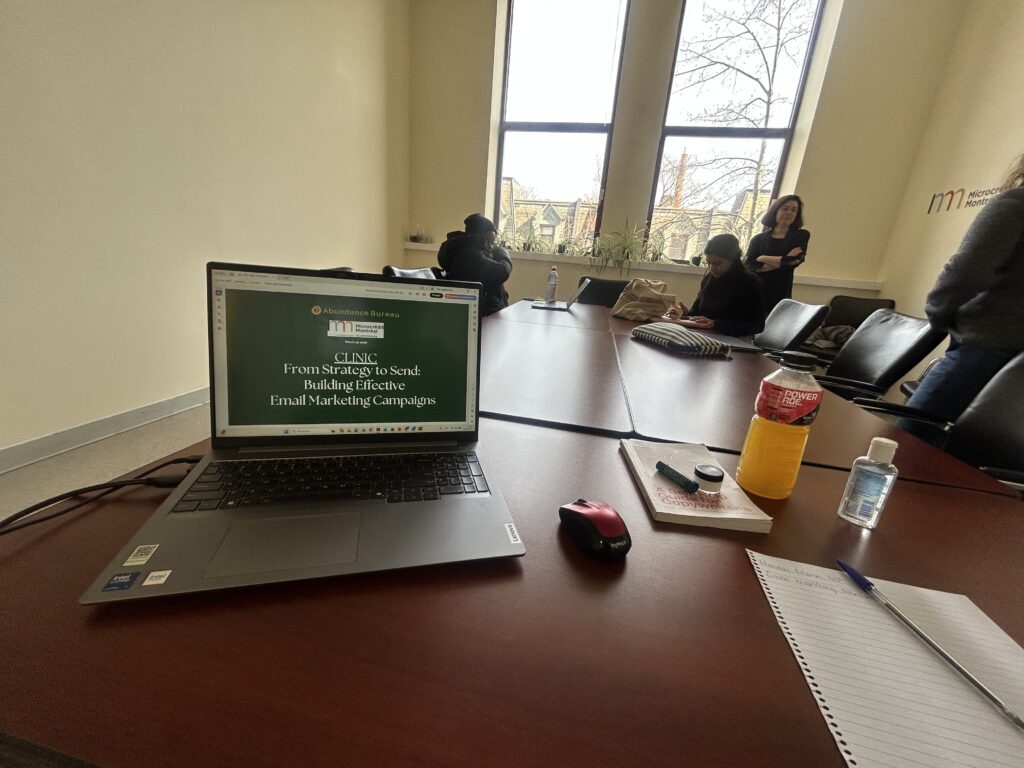
If your job is to support entrepreneurs, you already know the feeling. You bring in a speaker, the room nods along, and a few days later most participants are doing exactly what they did before. It is rarely because the content was weak. It is because information without structure almost never turns into action. Marketing workshops for entrepreneurs only create real momentum when they are built for the people in the room, not delivered from a slide deck that could belong to anyone.
I am Rose Napoléon, founder of Abundance Bureau. I have spent years designing and delivering bilingual marketing and sales workshops for organizations that support entrepreneurs across Canada. This article is written for the person on the other side of that decision: the program coordinator, the incubator manager, the person responsible for employee training in a small business. If that is you, here is what actually matters when you choose a workshop, and what separates one that lands from one that fades by Friday.
In this article
- What makes marketing workshops for entrepreneurs actually work
- Why information is not the same as momentum
- What to look for when choosing a workshop facilitator
- Why marketing and sales belong in the same room
- How to measure the impact of a workshop
- What a real shift looks like in the room
- Questions coordinators ask before booking
What makes marketing workshops for entrepreneurs actually work
The best marketing workshops for entrepreneurs share one quality: they meet people where they are. A room full of early-stage founders is not a room full of blank slates. Most of them already have a service or a product they believe in. What they are missing is not more theory. It is clarity, structure, and the confidence to talk about their work in a way that connects.
A workshop that works starts from that truth. It does not open with a definition of marketing. It opens with the participant’s real situation: the overwhelm of too many ideas, the fear of being seen, the confusion about where to even begin. When the content is anchored in what people actually feel, they lean in. When it is generic, they quietly check out, no matter how polished the slides are.
This is the first thing to look for when you evaluate a provider. Ask how they adapt the content to your cohort. If the answer is vague, the workshop will be too.
Why information is not the same as momentum
Here is the honest reason so many workshops fail to stick. Your participants leave with a notebook full of good ideas and no idea what to do first on Monday morning.
Information without structure does not create movement. It creates a longer to-do list, which for an overwhelmed entrepreneur can feel worse than doing nothing. The gap is not knowledge. The gap is sequence, priority, and a next step small enough to actually take.
A strong workshop closes that gap on purpose. Participants leave with one clear action, not forty. They leave knowing what to do next, not just what matters in theory. That is the difference between a session that entertains and a session that changes something.
When you are comparing options, this is the question that reveals the most: “What will my participants be able to do the day after, that they could not do the day before?” A facilitator who has thought carefully about that will give you a specific answer. One who has not will talk about the topics they cover.
What to look for when choosing a workshop facilitator
Choosing a facilitator is really about reducing your own risk. You are accountable for the programming, and a flat, forgettable session reflects on you, not just the speaker. Here is what genuinely protects you.
Real experience, not just a nice deck
Look for someone who has done the work they are teaching. There is a visible difference between a person who studied marketing and a person who has built brands, run campaigns, and sat across from clients. Entrepreneurs can feel that difference within the first ten minutes, and it earns their attention fast.
The ability to engage, not just present
Your quiet fear, and it is a fair one, is paying for a session where nobody accrues. Engagement is a skill, not a personality trait. Ask how the facilitator keeps a cohort involved: how they draw out the quiet participant, how they handle a group that has “seen every marketing talk before.” The best facilitators design for participation from the start.
Bilingual delivery, when your reality calls for it
If you serve both English and French speaking entrepreneurs, you know the challenge of finding programming that treats neither group as an afterthought. Genuine bilingual delivery, in English and in French Canadian, is rare and it matters. It means every participant experiences the same quality, in their own language, with the same warmth.
Measurable outcomes you can report
You often answer to a funder or a director. A facilitator who understands your world will help you capture outcomes you can actually report, and will be honest about what a single workshop can and cannot do. That honesty is a green flag, not a weakness.
Why marketing and sales belong in the same room
Many programs treat marketing and sales as two separate topics, booked on two separate days, sometimes with two different people. For most early-stage entrepreneurs, that separation creates a gap.
Marketing gets people interested. Sales turns that interest into a client. When you teach one without the other, participants learn how to attract attention they do not know how to convert, or how to close conversations they do not know how to start. Combining marketing and sales workshops for entrepreneurs gives them the full arc, from a stranger noticing them to a client saying yes.
For a founder who is doing everything alone, that complete picture is far more useful than two disconnected sessions. It is also more efficient for your programming, which is a real consideration when your calendar and your budget are both finite.
How to measure the impact of a workshop
This is the part almost no provider talks about honestly, so let me. A single workshop will not transform a business on its own, and anyone who promises that is overselling. What a good workshop does is create a shift: in clarity, in confidence, in the participant’s willingness to take the next step.
Some of that is measurable in the usual way. Attendance, completion, and satisfaction scores all belong in your report. But the wins that matter most are often the ones that do not fit neatly in a spreadsheet cell. The participant who finally stopped second-guessing her offer. The one who stopped hiding and started showing up. The founder who left able to describe her business in one clean sentence for the first time.
My practical advice: capture both. Track the numbers your funder expects, and collect one or two short participant reflections after the session. Those human quotes often tell the real story of impact better than any percentage, and they make your own reporting stronger.
What a real shift looks like in the room
Let me give you a picture, because this is what you are actually buying.
In one recent workshop, one participant barely spoke. She had built something real, a service people genuinely needed, but every time the conversation turned to promoting it, she got smaller in her chair. Near the end, we asked her to say out loud, in one sentence, what her business gives people. She hesitated. Then she said it.
And something changed in her face. Not because she had learned a new tactic, but because for the first time she heard her own value in her own words. That is the moment the work is for. Multiply it across a cohort and you understand why the right workshop is worth the care you put into choosing it.
That is also why the details on this page matter so much. The facilitator, the format, the engagement, the follow-through. They are what decide whether that moment happens in your room or not.
Questions coordinators ask before booking
What is the ideal group size for a marketing workshop for entrepreneurs?
Most engagement-driven marketing workshops for entrepreneurs work best with roughly eight to twenty five participants. Small enough that everyone can be drawn in, large enough to create energy and peer learning. Larger groups are possible, but they shift the format toward presentation and away from participation, so it is worth discussing your goals with the facilitator first.
Are virtual workshops as effective as in person?
They can be, when they are designed for the format rather than copied from an in-person session. A well-run virtual workshop uses breakout work, live interaction, and clear structure to keep a cohort involved. The wrong approach is a long lecture over video. Ask specifically how the facilitator adapts engagement for a screen.
Should marketing and sales be one workshop or two?
For early-stage entrepreneurs, combining them usually serves the participants better, because attracting interest and converting it are two halves of the same journey. Splitting them can make sense for more advanced groups who want to go deep on one. The right answer depends on where your cohort is, which is a good conversation to have before booking.
How do we measure the return on a workshop for our members?
Track the standard metrics your funder expects, and pair them with short participant reflections captured right after the session. The combination of numbers and human quotes gives you a fuller, more honest picture of impact, and it strengthens your own reporting.
Can a workshop be delivered in both English and French?
Yes, and if you serve both language communities it is worth prioritizing. Genuine bilingual delivery ensures every participant receives the same quality of experience in their own language, so neither group feels like an afterthought.
Bringing it together
Choosing a workshop is not really about filling a slot in your calendar. It is about giving the entrepreneurs you serve something that actually moves them forward, and protecting your own credibility while you do it. The right session is built for your people, closes the gap between information and action, engages every person in the room, and leaves you with outcomes you can stand behind.
If you are planning your programming and want to talk through what would fit your cohort, I would be glad to have that conversation. In the meantime, I hope this gave you a clearer lens for choosing well, whoever you decide to work with.
