
How Do You Teach Sales to Entrepreneurs?
What entrepreneurship organizations should look for in a sales workshop facilitator.
Sales is one of the most requested workshop topics in entrepreneurship programs, yet it remains one of the most challenging skills to teach effectively.
Every year, entrepreneurship organizations invest significant time and resources helping founders refine their business ideas, strengthen their marketing, and validate their offers. Yet many entrepreneurs continue to struggle with one of the most important drivers of business growth: turning conversations into paying clients.
The challenge rarely comes from a lack of passion or expertise. Most entrepreneurs know their products and services exceptionally well. They understand the value they provide and genuinely want to help their clients. What often feels uncertain is the sales conversation itself.
How do you approach a potential client without feeling awkward?
How do you lead a discovery call?
How do you explain your pricing with confidence?
What do you say when someone tells you they need to think about it?
How do you follow up without feeling like you’re bothering someone?
These questions are common across industries and business stages. They are also some of the most frequent questions entrepreneurship coordinators hear from the entrepreneurs they support.
For organizations, the challenge isn’t simply finding a sales workshop for entrepreneurs. It’s finding a facilitator who actively works in sales, understands today’s business environment, and can create a learning experience that leads to lasting behavioural change.
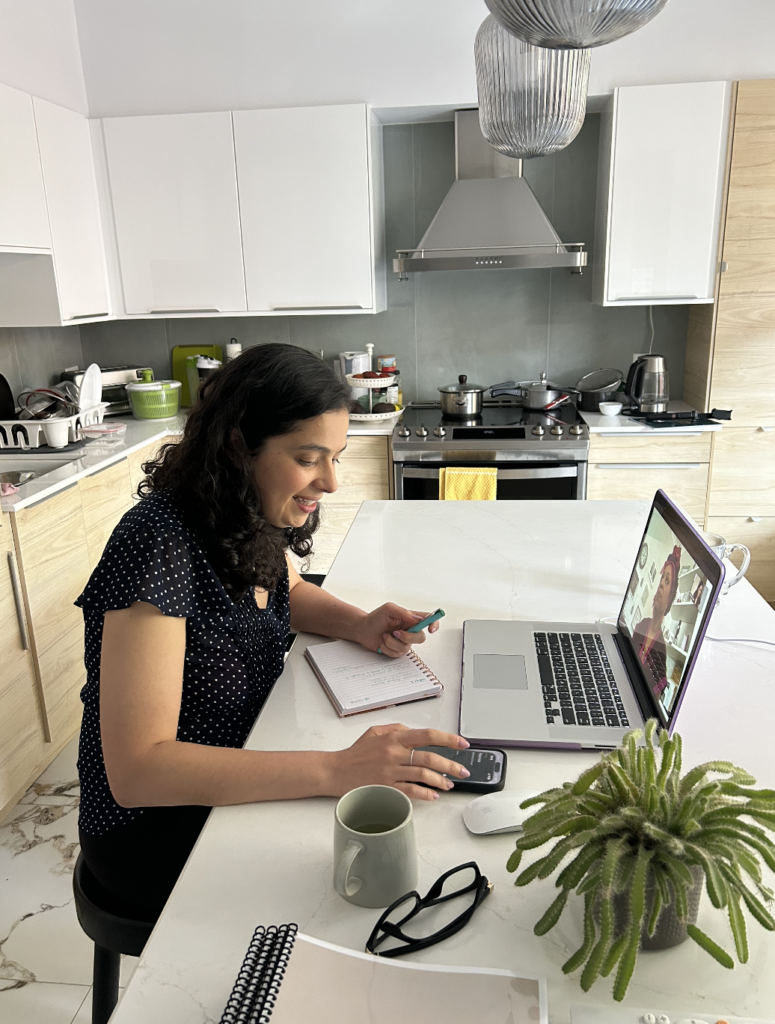
Our client Aimélène from Mon Oasis Breathwork during a discovery call.
At Abundance Bureau, we believe entrepreneurs don’t become better at sales by watching presentations.
They become better by practicing real conversations, receiving meaningful feedback, and building practical systems they can continue using long after the workshop ends.
Learn from someone who actively works in sales
One of the first questions any organization should ask before hiring a sales facilitator is simple.
Do they still sell?
Sales changes constantly. Buyer expectations evolve. Technology evolves. The way entrepreneurs build trust with prospective clients today is different from what it was five or ten years ago.
That’s why our workshops are grounded in active professional experience.
Rose Napoleon brings more than eight years of experience in B2B sales, business development, client management, marketing, and entrepreneurship. Alongside leading Abundance Bureau, she currently works in the sales department of a digital agency, where she manages the complete client journey from the first conversation through long-term account growth.
Her responsibilities include:
- New client acquisition
- Discovery calls
- Quotes and pricing conversations
- Contract renewals
- Client onboarding
- Relationship management and client retention
These aren’t examples from a previous career.
They are conversations she continues to have every week.
Alongside her corporate sales role, Rose continues to grow Abundance Bureau by selling workshops and consulting services to entrepreneurship organizations across Canada. This combination gives participants the opportunity to learn from someone who understands both the realities of selling professional services and the realities of running a business.
Over the years, she has also facilitated workshops for organizations including Microcredit Montréal, helping entrepreneurs strengthen their marketing, communication, and sales skills through practical, action-oriented learning.
Expert Insight
“One of the biggest misconceptions about sales is that confidence comes first. In reality, confidence comes from preparation and repetition. The more opportunities entrepreneurs have to practice meaningful conversations, the more natural those conversations become.”
Modern sales is changing
For decades, sales training focused primarily on persuasion.
Today, the most respected research tells a different story.
In The Challenger Sale, Matthew Dixon and Brent Adamson studied more than 6,000 sales professionals across a wide range of industries. Their research challenged one of the most common assumptions about selling.
Contrary to popular belief, the highest-performing sales professionals were not simply the strongest relationship builders. Instead, they consistently demonstrated three key behaviours:
- They taught clients something new about their business or challenges.
- They adapted every conversation to the client’s specific situation.
- They confidently guided decision making rather than simply responding to requests.
While The Challenger Sale focuses largely on complex B2B sales environments, its core principles are highly relevant for entrepreneurs.
Successful sales conversations are no longer about delivering the perfect pitch.
They’re about understanding people.
They’re about asking thoughtful questions.
They’re about helping clients recognize opportunities they may not have considered.
They’re about leading conversations with confidence instead of pressure.
That philosophy shapes every sales workshop we deliver.
Why traditional sales training often falls short
Many sales workshops focus heavily on theory.
Participants spend hours listening to presentations, taking notes, and discussing sales concepts. While this information can be valuable, it rarely prepares entrepreneurs for what happens when they sit down with a prospective client on Monday morning.
Adult learning research consistently shows that people retain significantly more information when they actively participate in the learning process rather than simply listening to it.
This principle is reflected in experiential learning models used across higher education, professional development, and corporate training.
For entrepreneurs, this matters.
Sales isn’t a subject that can be mastered through observation alone.
Like public speaking, negotiation, or leadership, it develops through experience.
That is why every Abundance Bureau workshop is built around active participation.
Participants don’t spend three or four hours listening to slides.
They spend those hours practicing.
We teach sales through experience
Our teaching philosophy is simple.
Explain.
Practice.
Reflect.
Apply.
Each new concept is introduced through a short learning segment before participants immediately apply it through realistic business scenarios.
Throughout the workshop, entrepreneurs may practice introducing their business during a networking conversation, leading a discovery call, presenting a proposal, discussing pricing, responding to objections, or following up with a prospective client after an initial meeting.
These conversations take place through guided role play, collaborative exercises, and facilitator coaching.
Participants receive immediate feedback, observe different communication styles, and refine their approach before applying these techniques in their own businesses.
The objective isn’t to teach entrepreneurs exactly what to say.
The objective is to help them understand why conversations succeed, how to adapt to different personalities, and when to guide clients toward the next step.
By the end of the workshop, participants haven’t simply learned about sales.
They’ve already experienced many of the conversations that will shape the future of their business.
We teach the entire sales process, not just the pitch
One of the biggest misconceptions entrepreneurs have is believing that sales begins when they present a proposal and ends when a contract is signed.
In reality, sales starts much earlier and continues long after a client says yes.
Successful entrepreneurs understand that every interaction contributes to the client experience. Finding qualified prospects, preparing for a discovery call, discussing pricing with confidence, following up consistently, onboarding new clients, and maintaining strong relationships all influence long-term business growth.
That is why our Sales Workshop for Entrepreneurs follows the complete client journey rather than focusing solely on closing techniques.
Participants learn how each stage connects to the next, helping them move from reactive selling to a repeatable business development process. Instead of viewing sales as a series of isolated conversations, they begin to see it as a system that supports sustainable growth.
Great conversations need great systems
One of the biggest surprises for many entrepreneurs is realizing that strong communication alone isn’t enough.
A discovery call can go exceptionally well, yet the opportunity may still be lost because there was no follow-up plan, no reminder to reconnect, or no place to record important information discussed during the meeting.
According to HubSpot’s State of Sales Report, sales professionals spend only a fraction of their week actively selling. A significant portion of their time is dedicated to preparing meetings, researching prospects, managing follow-ups, and maintaining customer information. High-performing sales professionals understand that organization is just as important as communication.
Entrepreneurs often experience the opposite challenge. They spend most of their time delivering client work while managing sales from memory, sticky notes, scattered emails, or notebooks. As their business grows, opportunities become increasingly difficult to track.
Teaching entrepreneurs how to organize their sales process is just as important as teaching them how to lead a sales conversation.
That is why every workshop includes practical discussions about creating a simple and sustainable sales system.
Depending on the entrepreneur’s stage of business, that system may be a well-designed Excel spreadsheet or a customer relationship management (CRM) platform. The objective is never to promote a specific software. It is to help participants choose a solution they will actually use.
Participants learn what information should be documented, how to prioritize follow-ups, how to organize their pipeline, and how simple habits can improve consistency over time.
Expert Insight
“The best CRM isn’t necessarily the most sophisticated one. It’s the one you’ll actually use every Monday morning. For some entrepreneurs that’s Excel. For others it’s a CRM. The tool matters less than building the habit.”
What actually happens during the workshop?
Many workshops promise to be “interactive.”
We prefer to show what that means.
Throughout the session, participants alternate between short teaching segments and practical activities designed to recreate the conversations they are most likely to experience in their own businesses.
For example, participants may begin by refining how they introduce themselves during a networking event before moving into a mock discovery call with another participant. Later, they may practice presenting a proposal, discussing pricing, responding to common objections such as “I need to think about it,” or conducting a follow-up conversation after an initial meeting.
Each activity is followed by a structured debrief. Participants reflect on what worked well, identify opportunities for improvement, and receive feedback from both the facilitator and their peers.
This collaborative learning environment allows entrepreneurs to observe different communication styles, gain new perspectives, and build confidence without the pressure of a real client conversation.
Rather than memorizing scripts, participants develop a flexible framework they can adapt to their own personality, industry, and clientele.
Why role play makes such a difference
Role play can feel intimidating at first.
Many participants worry about making mistakes or saying the wrong thing in front of others. Interestingly, those same participants often describe the role-playing exercises as the most valuable part of the workshop.
Why?
Because confidence isn’t created by listening.
Confidence is created by doing.
Entrepreneurs rarely have the opportunity to practice difficult conversations before having them with actual clients. During the workshop, they can test different approaches, receive immediate coaching, and improve in a supportive environment.
By the time they leave, they’ve already experienced many of the conversations that once felt intimidating.
That practical experience often translates into greater confidence, stronger client interactions, and a more consistent sales process.
Why entrepreneurship organizations choose hands-on workshops
Entrepreneurship organizations are increasingly looking for learning experiences that go beyond information sharing.
Their goal isn’t simply to expose participants to new ideas. Their goal is to help entrepreneurs develop practical skills they can apply immediately.
Hands-on workshops encourage active participation, peer learning, reflection, and immediate application. Instead of leaving inspired for a day, participants leave with experience.
For coordinators, this creates greater confidence that the learning will continue after the workshop has ended.
That philosophy has guided every Abundance Bureau workshop from the beginning.
Whether we’re teaching marketing, communication, artificial intelligence, or sales, our objective remains the same.
We help entrepreneurs move from understanding concepts to applying them with confidence.

What participants leave with
By the end of the workshop, participants leave with more than a collection of notes. They leave with practical experience, greater confidence, and a sales process they can begin applying immediately.
Participants leave with:
- A practical framework for managing the complete sales process, from prospecting to long-term client retention
- Hands-on experience leading discovery calls, discussing pricing, handling objections, and conducting follow-up conversations through guided role play
- Practical tools for organizing leads using either an Excel tracker or a CRM
- Greater confidence communicating the value of their services through authentic conversations
- A repeatable sales process they can immediately implement in their own business
More importantly, participants leave knowing they have already practiced many of the conversations they will have with prospective clients the following week.
What organizations can expect
For entrepreneurship organizations, a successful workshop is measured by more than participant satisfaction.
The real question is whether entrepreneurs leave better equipped to grow their businesses.
Our workshops are designed to increase participation, encourage collaboration, and create opportunities for entrepreneurs to learn from one another while receiving expert guidance. Every activity is intentionally connected to situations participants are likely to encounter outside the classroom.
Organizations that work with Abundance Bureau can expect a workshop that is practical, engaging, and adaptable to the needs of their participants. Whether working with first-time founders or experienced business owners, the content is adjusted to reflect their level of experience, industry, and business goals.
What participants are saying
The greatest measure of any workshop is what participants do after it ends.
Over the years, entrepreneurs who have participated in Rose Napoleon’s workshops and coaching programs have shared how practical sales coaching helped them build confidence, improve their sales conversations, and generate new business opportunities.
One participant reported increasing her average monthly business revenue after consistently applying the strategies discussed during weekly sales coaching sessions. Others have highlighted the value of having a facilitator who combines accountability with practical business advice, helping them identify gaps in their sales process and develop more effective ways of communicating with prospective clients.
Organizations such as Microcredit Montréal have also trusted Abundance Bureau to deliver workshops that respond to the real needs of the entrepreneurs they support.
Why organizations choose Abundance Bureau
Entrepreneurship organizations don’t need another generic sales presentation.
They need facilitators who understand entrepreneurship, actively work in sales, and know how to transform theory into practical learning experiences.
At Abundance Bureau, our workshops combine:
- More than eight years of experience in sales, business development, marketing, and entrepreneurship
- An active role in B2B sales, ensuring every workshop reflects today’s business realities
- Evidence-informed practices inspired by modern sales research
- Hands-on learning through role play, collaborative exercises, and facilitator coaching
- Practical business tools that participants can continue using after the workshop
This combination allows organizations to offer training that prepares entrepreneursfor the conversations that directly influence the growth of their businesses.
Expert Insight
“One of the biggest mistakes I see entrepreneurs make isn’t during the sales conversation. It’s after the meeting. They leave without scheduling a follow-up, documenting next steps, or creating a clear action plan. That’s why we teach the entire sales process, not just the conversation.”
Frequently Asked Questions
